Most managers are not short of information.
They have dashboards, reports, spreadsheets, management accounts, CRM data, project updates and performance reviews. In many organisations, almost anything can be measured. The problem is no longer a lack of data. The problem is knowing where to focus.
When everything appears important, nothing receives enough attention.
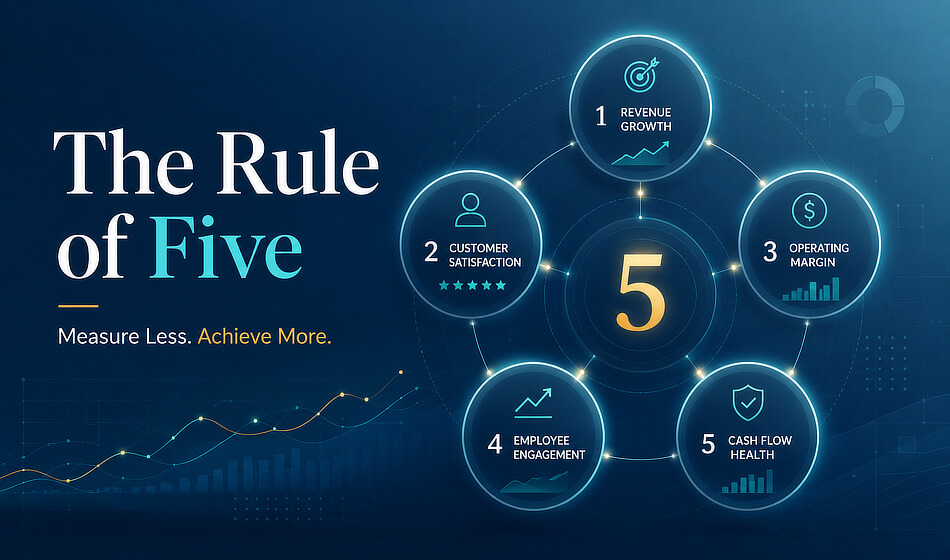
That is the thinking behind The Rule of Five:
Focus on the five measures that drive your business.
The Rule of Five is not an argument against measurement. Nor does it suggest that a business should only have five KPIs. Most organisations need far more than that to operate effectively. Finance teams need detailed financial measures. Sales teams monitor pipelines, conversions and revenue. Operations teams track quality, productivity and delivery. Larger organisations may have hundreds of measures across different departments.
The distinction is between everything a business measures and the small number of measures a manager actively monitors.
A manager cannot pay close attention to everything every day. There is too much information and too little time. The Rule of Five creates a manageable level of focus.
Why fewer measures can be more useful
A large dashboard can look impressive. It may contain dozens of charts, tables and indicators. But the more information it contains, the harder it becomes to see what really matters.
This is not simply a problem of presentation. As the Harvard Business Review explains in its examination of what KPIs are really measuring, management teams can become overwhelmed and disengaged when performance information is sliced into too many measures.
A manager reviewing twenty or thirty measures may notice that several have changed. They may also struggle to decide which change deserves attention first. The result can be analysis without action.
By contrast, a small group of carefully selected measures creates clarity.
Five measures can be reviewed quickly. Their trends can be understood. Changes become easier to spot. A manager can ask useful questions:
- Why has this measure moved?
- Is the change temporary or part of a trend?
- Does it require action?
- Who needs to be involved?
- What should happen next?
The purpose of a KPI is not simply to report what has happened. Its value comes from helping someone decide what to do.
A measure that does not influence a decision may still be useful for reporting, but it probably does not belong in a manager’s critical five.
Why five?
Five is not a scientific law, and it should not be treated as an inflexible rule.
The point is discipline.
If a manager chooses only one or two measures, the picture may be too narrow. Important parts of the organisation could be overlooked. If they choose ten, fifteen or twenty, the list may become too broad to guide day-to-day attention.
Five is enough to provide balance while remaining easy to remember and review.
It encourages managers to make choices. Which measures really indicate whether the business, department or team is moving in the right direction? Which ones provide an early warning? Which ones reflect the outcomes for which the manager is personally responsible?
Selecting five measures is not always easy. That is part of the value of the exercise.
Managers who need help with this process can begin by looking at how to choose the right KPIs and connect them to their organisation’s priorities.
The process forces a manager to separate the critical from the merely interesting.
The five should reflect responsibility
There is no universal list of five KPIs that works for every manager.
A managing director might focus on revenue, gross margin, cash, customer retention and employee capacity.
A sales director might monitor qualified pipeline, conversion rate, average deal value, sales cycle length and revenue against target.
An operations manager might focus on output, quality, delivery performance, downtime and cost per unit.
A customer service manager may choose response time, resolution time, customer satisfaction, unresolved cases and repeat contacts.
The measures should reflect the part of the organisation the manager can influence.
This is important. Managers should not fill their five positions with measures simply because those figures are easy to obtain. The best measures are connected to their responsibilities, priorities and decisions.
A useful question is:
If this measure changed significantly, would I need to do something?
If the answer is no, it may not be one of the five.
Monitoring is not the same as reporting
The Rule of Five does not replace monthly management accounts, quarterly performance reviews or detailed operational reporting.
Those activities remain essential.
Monthly and quarterly reviews provide an opportunity to examine performance in depth. They may include wider trends, supporting measures, departmental reports, project milestones, forecasts and risk information.
The Rule of Five serves a different purpose.
It is designed for regular monitoring between those formal reviews. Depending on the measure, this may mean checking performance daily, weekly or monthly.
The aim is to create an early-warning system.
A manager should not have to wait until the end of the quarter to discover that enquiries have been falling for six weeks, delivery times are slipping or cash collection is deteriorating.
Regular attention to five critical measures makes it easier to identify change while there is still time to respond.
Choosing leading and lagging measures
A good set of five usually includes a mixture of outcomes and drivers.
Outcome measures, sometimes called lagging indicators, show what has already happened. Revenue, profit, customer retention and completed orders are common examples.
Driver measures, often called leading indicators, show what may happen next. Sales enquiries, proposals issued, production delays, staff absence or customer complaints may provide advance warning of future results.
A business owner who tracks only revenue may see the problem too late. Revenue tells them what has already been achieved.
If they also monitor qualified opportunities or new customer enquiries, they gain an earlier view of future performance.
The strongest set of five therefore does more than describe the past. It helps the manager anticipate what may happen next.
The five can change
The Rule of Five is not a one-time exercise.
The measures that matter most today may not be the measures that matter most in six months.
A growing business may initially focus on sales and capacity. Later, cash flow and profitability may become more important. During a major implementation, project progress and customer adoption may temporarily become critical. A business facing service problems may need to focus on quality and customer satisfaction.
Managers should review their five periodically and ask whether each measure still deserves its place.
Changing a KPI is not a sign that the original choice was wrong. It may simply mean that the organisation’s priorities have changed.
The important thing is to avoid changing the measures so frequently that trends become meaningless. The five should be stable enough to guide attention, but flexible enough to remain relevant.
From information to action
The real benefit of The Rule of Five is not the number five.
It is the habit of focused management.
A manager who regularly monitors five well-chosen measures develops a clearer understanding of performance. They begin to recognise normal variation, unusual changes and emerging trends. Conversations become more specific. Meetings become more focused. Decisions can be made sooner.
Instead of asking, “How is the business doing?”, the manager can ask:
- Why has customer retention fallen?
- What caused the increase in delivery delays?
- Why is the sales pipeline improving without a corresponding increase in orders?
- What action will bring this measure back on track?
These are better management questions because they are grounded in evidence.
Measure less. Achieve more.
Most organisations do not need more data.
They need more clarity about which data deserves attention.
The Rule of Five provides a simple framework. Continue to measure everything your organisation needs for reporting, control and compliance. But identify the five measures that require your personal attention.
Monitor them regularly.
Understand why they change.
Act when action is needed.
That is the principle behind My5 KPIs and the reason for its simplicity.
When managers focus on the five measures that drive their business, they spend less time searching through information and more time improving performance.