
What is KPI Management?
Successful KPI Management
Most organisations already collect huge amounts of business data. The challenge is not gathering information — it is knowing which metrics actually matter and using them to improve performance, accountability and decision-making.
That is where KPI management becomes important.
KPI management is the process of selecting, tracking, reviewing and improving the measures that help an organisation achieve its strategic and operational goals. Done well, KPI management helps teams stay focused, identify problems earlier and make better decisions based on real evidence rather than assumptions.
But successful KPI management is not simply about creating dashboards or producing reports. It is about creating a culture where performance is understood, communicated and continuously improved.
What Does it Look Like?
There are two essential elements to effective KPI management.
Firstly, organisations must choose the right KPIs. Secondly, those KPIs must be embedded into everyday processes, reporting and decision-making.
If both elements work together, teams become more focused, productivity improves, and managers gain far greater visibility into what is really happening across the organisation.
The best KPI management systems do not overwhelm people with data. They help organisations focus attention on the measures that genuinely influence success.
Keep KPI Reporting Simple
The KISS principle — Keep It Simple, Stupid — applies perfectly to KPI management.
Many organisations fail because they attempt to measure everything. The result is usually confusion, reporting fatigue and dashboards nobody actually uses.
Good KPI management focuses on the measures that truly matter.
As a general rule, three to five KPIs per strategic objective is often enough. This creates clarity and encourages teams to focus on meaningful outcomes rather than endless reporting.
When KPI reporting becomes too complex, people stop engaging with it.
Choose the Right KPIs
Selecting KPIs sounds straightforward, but this is often where organisations struggle most.
A useful starting point is to ask a simple question:
Which few pieces of business information would you want to see first thing every morning?
The answers usually reveal the metrics that matter most.
Once identified, those KPIs should then be checked against the organisation’s strategic goals. A KPI should never exist simply because data is available. It should help measure progress towards an important business outcome.
Strong KPIs are usually:
- Clearly defined
- Measurable
- Relevant to business goals
- Easy to understand
- Able to influence behaviour and decision-making
- Reviewed consistently over time
Align KPIs With Strategic Goals
KPIs are most effective when linked directly to strategy.
Without this connection, organisations often end up measuring operational activity that has little impact on long-term success.
SMART criteria remain a useful framework when defining KPIs and objectives:
- Specific — Everyone understands what is being measured
- Measurable — Progress can be quantified
- Attainable — Targets are realistic
- Relevant — The KPI supports strategic priorities
- Time-bound — Progress is reviewed within a defined timeframe
This alignment between strategy and measurement is what transforms KPI reporting from a management exercise into a genuine performance improvement tool.
Avoid Departmental Silos
One of the biggest challenges in KPI management is preventing departments from working in isolation.
Teams naturally focus on their own targets, but this can sometimes damage wider organisational performance.
For example, a customer service department may improve response times by increasing staffing levels — while finance teams become concerned about rising operational costs. Both teams may technically achieve their KPIs while the organisation itself becomes less efficient.
This is why KPI management must encourage collaboration rather than competition between departments.
The most successful organisations create shared visibility across teams so managers understand how their actions affect the wider business.
Communicate the ‘Why’, Not Just the ‘What’
Simply telling staff what the KPIs are is not enough.
People also need to understand:
- why the KPI matters
- how it supports business objectives
- how success will be achieved
- who is responsible for progress
When employees understand the context behind KPIs, the measures become more meaningful. Teams become more engaged, more innovative and far more likely to take ownership of results.
A KPI should always support a business objective or desired outcome. Measuring data simply because it exists creates unnecessary reporting with little real value.
Use Strategy Maps and Visual Reporting
Many organisations use strategy maps and dashboards to help communicate KPIs visually across the business.
A Strategy Map helps employees understand how operational activity connects to wider strategic objectives, while dashboards provide real-time visibility into current performance.
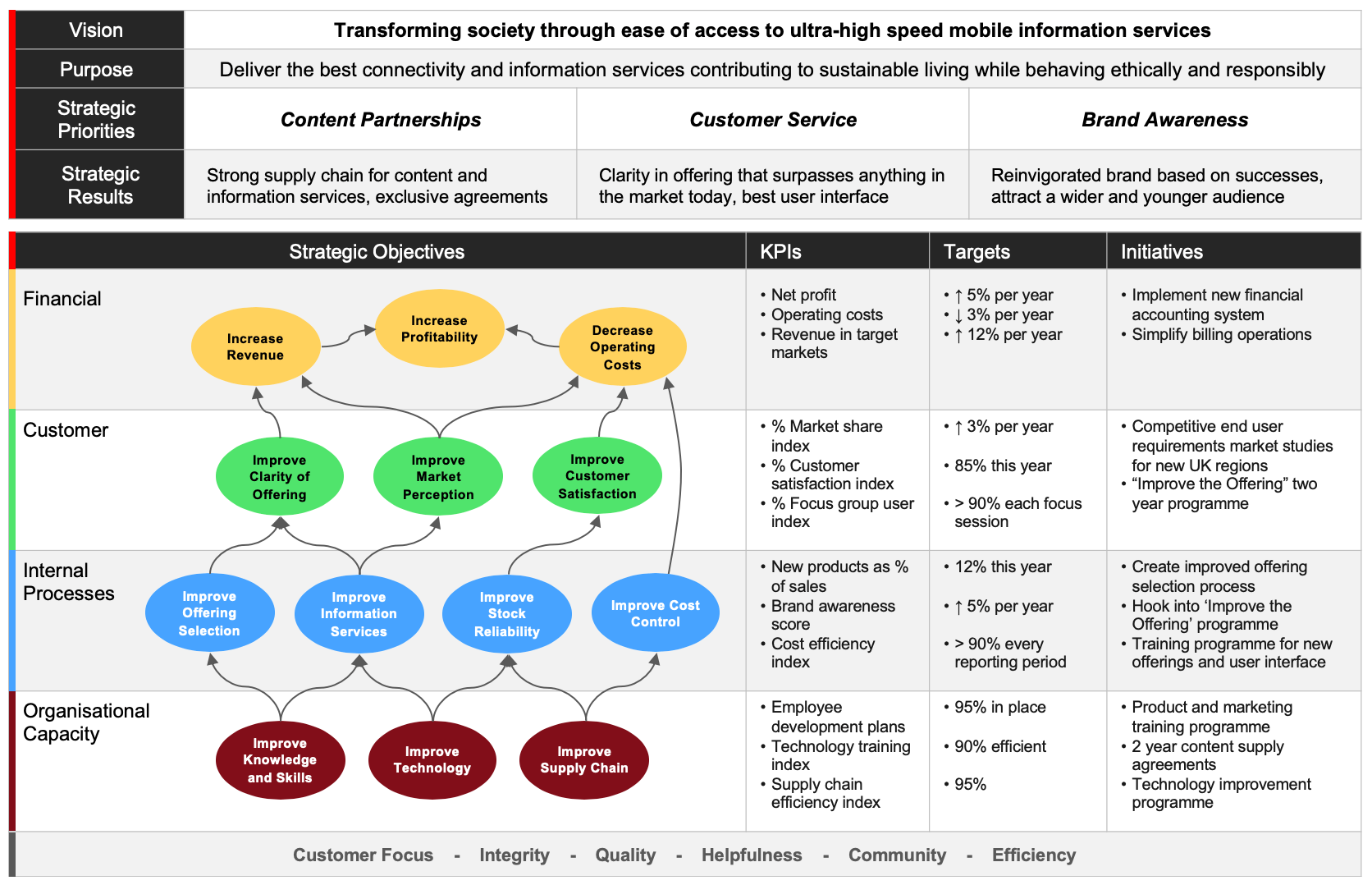
Click on image to enlarge
Used properly, dashboards become powerful management tools rather than static reports.
Effective dashboards should:
- be easy to understand
- focus attention on priorities
- provide clear ownership
- highlight trends and risks
- encourage action and discussion
Create KPI Dashboards That Stay Alive
A dashboard is only valuable if people actively use it.
One of the most common failures in KPI management is creating dashboards that quickly become outdated or ignored.
Successful KPI reporting requires:
- regular updates
- accurate data
- commentary and context
- management discussion
- accountability for actions
The goal is not simply to display information. The goal is to improve decision-making.
Many organisations begin KPI reporting using spreadsheets, but as reporting requirements grow, manual processes often become difficult to maintain. Dedicated KPI software can automate reporting, improve data consistency and provide real-time visibility across teams and departments.
Spider Impact KPI Software helps organisations manage KPIs, automate reporting, align objectives and track strategic performance in a single platform.
Consider KPI Pairing
Good KPI management requires balance.
If teams focus too heavily on one measure, unintended consequences can appear elsewhere.
For example:
- improving customer response times may increase operational costs
- increasing sales may reduce profitability
- maximising utilisation may reduce quality or employee well-being
A useful technique is KPI pairing.
This involves monitoring related KPIs together to create checks and balances across performance.
Examples include:
- customer satisfaction alongside cost-to-serve
- sales growth alongside profit margin
- productivity alongside quality measures
Balanced KPI management helps organisations improve performance sustainably rather than optimising one area at the expense of another.
Common KPI Management Mistakes
Many KPI programmes fail for predictable reasons.
Common mistakes include:
Tracking Too Many KPIs – When everything is measured, nothing feels important.
Measuring Activity Instead of Outcomes – Busy teams are not always productive teams.
Lack of Ownership – KPIs without accountability rarely improve.
Disconnected Reporting – Operational metrics should support strategic goals.
Outdated Dashboards – Reports quickly lose credibility if data is inaccurate or delayed.
Ignoring KPI Reviews – KPIs should evolve as business priorities change.
Recognising these problems early can dramatically improve the success of KPI management initiatives.
Know When to Change Your KPIs
KPIs should never become fixed permanently.
Business priorities change. Markets change. Customer expectations change.
As organisations evolve, KPIs must evolve too.
Regular KPI reviews help organisations identify:
- outdated measures
- duplicated reporting
- changing priorities
- emerging risks
- new strategic opportunities
Sometimes, a KPI should be retired completely. In other cases, it may simply need a lower priority or a revised target.
The important thing is to ensure KPIs continue supporting the direction of the organisation rather than becoming reporting habits from the past.
In Conclusion
Successful KPI management is not about creating more reports or collecting more data.
It is about helping organisations focus on what matters most, improve accountability and turn strategy into measurable results.
When KPIs are selected carefully, communicated clearly and supported by effective reporting tools, they become far more than numbers on a dashboard. They become part of the organisation’s decision-making culture.
With the right processes, the right measures and the right software, KPI management can help organisations move from reactive reporting to proactive performance improvement.
To learn more about KPI reporting, dashboards and strategic performance management, explore Intrafocus KPI Software Solutions.
Resources:
Start with What is a KPI?
For information on how to create clear objectives and goals and how to design meaningful key performance indicators, download our guide:

If all you need is a list of KPIs classified by industry or role, please feel free to download our Sample KPI Document. It contains lists of KPIs as used by real companies and organisations.