
Many organisations fall into the same trap. They try to evaluate AI by tracking the tools: how many prompts were issued, how many queries were processed, or which model version was used.
These numbers may interest IT teams, but they do not help leaders make strategic decisions. They do not reveal whether AI is improving service, strengthening processes, or reducing costs.
Strategy directors need something different.
They need to understand whether AI is delivering results that align with the strategic plan. This mirrors a broader shift in organisational performance: technology is no longer judged by novelty but by contribution.
Without a clear set of outcomes, organisations cannot steer AI effectively. Performance becomes anecdotal, and investment decisions rely on enthusiasm rather than evidence.
The good news is that leaders already have a framework for this. Most organisations use a Balanced Scorecard or a similar approach to translate strategy into measurable objectives.
AI should follow the same logic. When AI is assessed through a strategic lens, it becomes easier to identify where it accelerates progress and where it distracts from priorities.
This brings us to four domains that provide a simple, structured way for strategy directors to assess AI performance across the organisation.
Four Ways AI Shows Its Value (Without Showing Off)
To evaluate AI in a strategic context, leaders must move beyond technical metrics and focus on meaningful outcomes.
We recommend organising measures into four domains: efficiency, accuracy, quality, and readiness.
Each reveals a different aspect of AI performance and aligns neatly with the Balanced Scorecard.
Efficiency: capture how AI improves workflow speed and reduces manual effort. This domain focuses on productivity outcomes such as time saved, process cycle time, and increased throughput. It shows whether AI is genuinely removing friction or simply adding another layer of activity.
Accuracy: measure how reliably AI produces correct information. This is critical for areas such as reporting, customer communication, forecasting, and risk analysis. Accuracy metrics allow leaders to compare AI outputs with human benchmarks and track improvement over time.
Quality: reflect whether AI outputs meet required standards. This includes clarity, usefulness, compliance with internal guidance, and alignment with strategic objectives. Quality matters because an output can be accurate yet unhelpful, especially in complex decision-making.
Readiness: evaluate the organisation’s capability to use AI effectively. It includes data quality, user adoption, governance maturity, and training participation. AI success depends heavily on these enablers; without them, even the best models produce unreliable outcomes.
Together, these domains give leaders a balanced, practical way to track AI performance. They avoid technical complexity while providing insight that supports better decisions.
KPIs That Actually Tell You Something
Most organisations do not need advanced analytics to measure AI. A small set of well-chosen KPIs is enough to reveal where AI is contributing and where it requires intervention. Here are some practical examples for each of the four domains.
Efficiency
Objective: Reduce manual effort across core processes.
KPIs:
- Percentage of reports generated using AI-assisted workflows.
- Average time saved per task through AI-enabled automation.
- Number of hours reallocated from administrative work to higher-value activities.
These KPIs help leaders see whether AI is freeing capacity or simply shifting workload.
Accuracy
Objective: Improve reliability of information used in decision-making.
KPIs:
- Accuracy rate of AI-generated outputs compared with human review.
- Error reduction in customer-facing documents produced with AI support.
- Variance between AI-generated forecasts and actual results.
Accuracy measures give leaders confidence in AI’s contribution to quality and risk reduction.
Quality
Objective: Ensure AI outputs meet organisational standards and support strategic aims.
KPIs:
- Quality score of AI-generated insights based on user evaluation.
- Compliance rate with internal style, process, or regulatory requirements.
- Percentage of AI outputs accepted without modification.
Quality KPIs help organisations focus on usefulness rather than novelty.
Readiness
Objective: Build the organisational capability required to scale AI responsibly.
KPIs:
- User adoption rate of AI tools across functions.
- Percentage of critical datasets meeting quality thresholds.
- Governance maturity score, including oversight processes and role clarity.
Readiness KPIs reveal whether the organisation is positioned to make long-term gains from AI.
Taken together, these measures give leaders a clear and balanced view. More importantly, they can be directly linked to strategic objectives and represented on a Strategy Map. This ensures AI is not treated as a stand-alone initiative but as part of the organisation’s growth path.
Learn more: Strategy Scorecard Software (EMEA) via Intrafocus. Request a 30-day trial.
Seeing AI’s Story Unfold
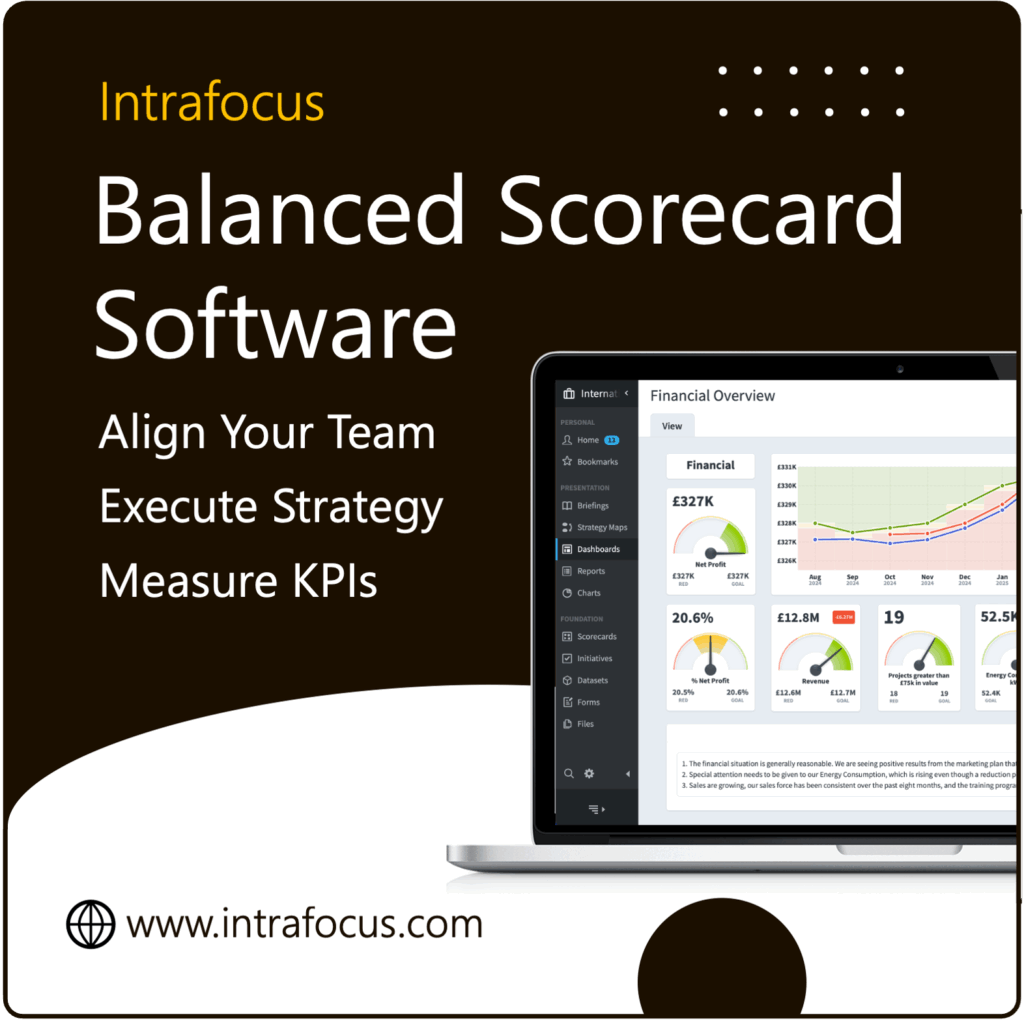
Measurement only becomes meaningful when it is visible and understood. This is where Spider Impact adds significant value. The platform provides a clear way to translate AI objectives and KPIs into visual dashboards, strategy maps, and performance trends.
For strategy directors, this creates an immediate advantage. AI performance is no longer hidden in technical reports or tool-specific dashboards. Instead, it sits alongside other strategic measures, showing how AI contributes to organisational goals.
For example, Spider Impact can display:
- A trend chart showing the improvement of AI accuracy over three consecutive quarters.
- A performance gauge revealing how efficiency has increased through automation.
- A Strategy Map highlighting where AI strengthens internal processes or informs decision-making.
Because the software already supports the Balanced Scorecard structure, no redesign is needed. AI objectives sit naturally within the Organisational Capacity, Internal Process, Customer, or Financial perspectives depending on their purpose.
This integrated view is vital. It removes the perception of AI as a side project and positions it as a capability that supports strategy execution. Leaders gain transparency, and teams gain alignment around shared measures.
Clear Measures, Smarter Moves
AI will continue to evolve, and new tools will appear regularly.
But the core challenge for leaders remains the same: ensuring AI strengthens the organisation rather than complicating it. Measurement is the link between experimentation and strategic impact.
When the focus is on outcomes, clarity is gained to guide investment, build capability, and scale success.
AI does not need more technical measurements. It needs better strategic measurement. The organisations that succeed will be those that treat AI as a capability governed by clear objectives, meaningful KPIs, and transparent performance reporting.
If you want to understand how AI contributes to your strategy, Intrafocus can help. Our team works with organisations to define clear AI objectives, design practical KPIs, and use Spider Impact to bring performance to life across the business.